
In today’s time, the way people search changes rapidly. They are no longer typing short keywords into Google and scrolling through a lot of websites to get the right information. Instead, they’re asking AI tools like ChatGPT, Perplexity, and Gemini for immediate answers. They want simple answers, recommendations, and solutions, rather than exploring lengthy lists of websites.
Because of this new shift, businesses now need to rethink before creating content. Generic SEO is no longer enough; now you need smart strategies that show your content to AI assistants like ChatGPT, Perplexity, and Gemini.
Brands need to understand Answer Engine Optimization (AEO) and Generative Engine Optimization (GEO) if they want to stay visible or increase organic traffic. If you’ve been wondering what the future of SEO in 2026 really looks like, this guide breaks it down clearly and simply.
What Is Answer Engine Optimization (AEO)?
Answer Engine Optimization (AEO) is a digital marketing technique that focuses on optimizing content so it can appear directly in search results, rather than just ranking a webpage.
The main focus is on AI Overviews, featured snippets, and voice search, desiring for content to be mentioned directly in the generated response. AEO ensures that the provided content is clear, structured, and trustworthy, making it easy for AI systems to pull and present as a definitive answer to every user.
If we look into the past, SEO was just about ranking on Google, and people focused on this only. But today’s things switch, and business owners need to understand AEO to show up their content when someone asks an AI:
- “How do I fix this?”
- “What’s the best option for me?”
- “Explain this in simple terms.”
To give accurate results to users, AI tools pull answers from websites they trust. If your content isn’t clear, structured, and helpful, AI may not use it.
How Search Has Changed: SEO → AEO → GEO?
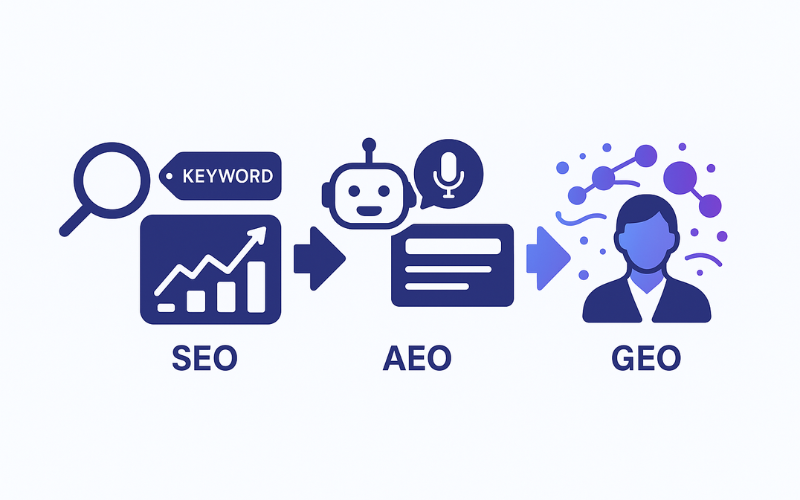
Search has changed a lot. First, SEO was about getting your website to show up in Google’s list. Then AEO focused on giving clear answers for things like snippets and voice search. Now, GEO is about making sure AI tools, like ChatGPT and Perplexity, use your content in their answers and summaries.
This transformation is caused by AI, which has modified how users get information. Now people are moving from clicking links to getting answers directly within the search interface, which saves time and gives the proper results.
In short, you can understand like this:
- SEO helps people find your website.
- AEO helps search engines and AI tools find clear answers on your website.
- GEO helps AI assistants use your website to create full answers and summaries.
How ChatGPT, Perplexity, Gemini & Others Impact Your Visibility?
AI models are changing online visibility. The focus has shifted from ranking higher in search results to being mentioned in AI-generated answers. These models act as “answer engines” that give direct answers, which lowers the need for users to click on websites.
AI tools seriously impact brand visibility by changing how content is created, found, and consumed. The key effects are:
- Your website can get less traffic as users often receive direct answers from AI overviews rather than clicking on websites.
- AI models favor strong E-E-A-T. Content: without this, your content gets skipped.
- Make sure to organize the content more; otherwise, your overall online visibility can drop.
- AI matches content to user intent, showing brands that answer the question best.
How to Optimize Content for AI Tools (AEO + GEO Tips)?
To optimize content for AI tools (AEO + GEO):
- Make sure to add structure and clear headings and lists, write straightforward answers of 50-70 words at the start, and use natural, conversational language, so AI tools can quickly find what they need.
- Ensure content is authoritative and updated. Show that you know what you’re talking about by including your experience, expert quotes, or helpful examples, and make sure to cover the whole topic, not just part of it.
- Keep your content well-organized so AI can read it easily. Include schema markup like FAQ, and use semantic SEO with related terms to give AI more context.
- AI assistants choose the clearest and most trustworthy content. If your writing is messy or incomplete, they may not use it.
Voice and Conversational Search Trends for 2026
Voice search has flourished thanks to better microphones, faster processing, and multimodal AI. Users now ask longer, conversational questions and expect personalized, spoken-friendly answers with relevant content.
To make your content optimized for voice search, you need:
- Shorter sentences
- Easy-to-read aloud phrasing
- Intent-focused content
- Local relevance
Real Examples of How Brands Are Adapting
Here’s how modern brands are succeeding in the AI-first search world:
- News publishers add short AI-ready summaries at the top of articles.
- B2B SaaS companies create a reliable answer for chatbots.
- Travel brands use structured itineraries to assist AI in developing trip plans.
- E-commerce writers use Q&A-style product descriptions for exact AI understanding.
Conclusion
In 2026, SEO will be a combination of data-driven, AI-powered strategies and authentic human experiences, with a focus on AI-friendly, E-E-A-T, and user intent content. Don’t think SEO is dead; it has transformed into something intelligent and experience-driven.
Now only those will succeed who prioritize real expertise instead of keyword stuffing, create content intentionally prepared for AI assistants and answer engines, and focus on trust signals rather than just tracking traffic. Businesses should adopt AI tools and a human-centric process to provide long-term visibility and user trust. The sooner brands welcome this shift, the more visible and competitive they’ll be as search continues growing.